Virgin vs Recycled: Practical Guidance for B2B Packaging Buyers
– A Technical & Market-Oriented Guide for Non-Woven Bag Decision Makers
Summary Outline
1. Virgin PP offers higher stability for strength, printing, and brand-risk control.
2. Recycled PP supports lower cost and sustainability goals with certain performance trade-offs.
3. Filler masterbatch influences stiffness, appearance, and print behavior.
4. Hybrid blends give B2B buyers balanced performance and cost efficiency.
5. Buyers should evaluate brand tolerance, application needs, and consumer expectations.
Introduction
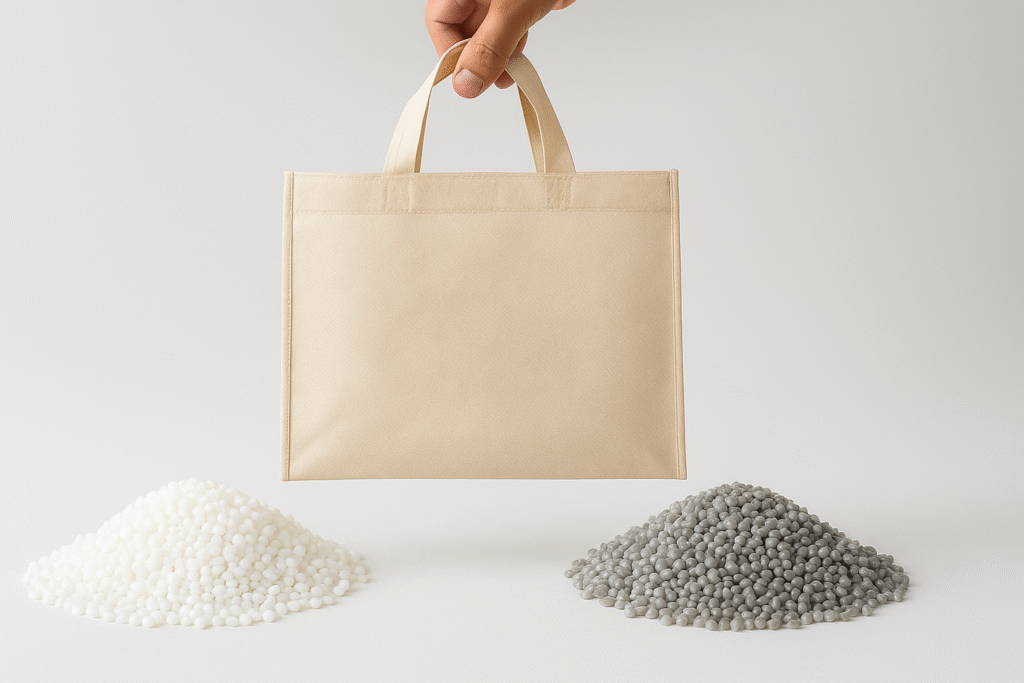
Packaging buyers often face a critical choice: use virgin polypropylene or recycled materials for non-woven bags. This decision influences cost, durability, print quality, and environmental value. Understanding the role of filler masterbatch—and how different material combinations behave—helps B2B buyers make reliable decisions in a market where sustainability and cost pressure both continue to rise.
Although this website is newly built, I have worked in domestic sales and share an office with colleagues who have been in foreign trade for many years. Daily conversations with them allow me to observe real buyer concerns, order structures, claims, and feedback from multiple market segments. These experiences form the practical perspective of this article.
To help B2B buyers think clearly, this article follows a U-shaped thinking approach: Start from buyer pain points → unpack the technical truth → return to the most practical buying choices.
Why This Topic Matters in 2025
Across supermarkets, wholesalers, and private-label brands, I’ve noticed one shift: buyers now judge materials not only by price, but by risk.
Risk of color inconsistency.
Risk of tensile failure.
Risk of consumer complaints.
Risk of sustainability backlash.
Consumers ask more questions. Governments push recycled content rules. Retailers must show responsible sourcing. And factories face increasing material-price instability.
For these reasons, B2B buyers now ask:
“Which material composition gives stable performance without hurting margins or brand reputation?”
To answer that, we must first understand filler masterbatch.
1. The Role of Filler Masterbatch in Non-Woven Fabric
1.1 What it contains
Common masterbatch types include:
• calcium carbonate (CaCO₃)
• talc
Mixed as pellets with PP resin.
1.2 Why factories actually use it
Filler masterbatch helps:
• reduce material cost
• increase stiffness so bags feel structured
• improve dimensional stability
• reduce shrinkage during cooling
• enhance print ink absorption
• reduce static issues on high-speed machines
• improve processing efficiency
But excessive filler content causes:
• lower tensile strength
• chalky surfaces
• reduced tear resistance
For B2B buyers, “right proportioning” is more important than “add more to save cost.”
2. Virgin PP: When Stability Matters Most
Benefits for B2B buyers
• Consistency
Virgin PP provides predictable GSM, color uniformity, and fiber behavior.
• Strength
It has better tensile and tear properties because fibers stretch evenly during extrusion.
• Print Precision
Pantone colors, CMYK gradients, and full-surface artwork print cleaner on virgin-based fabric.
• Lower defect risk
Fewer issues with odor, impurities, or weak spots.
When buyers choose virgin PP:
• export orders with strict QC
• premium branding
• heavy-load bags
• detailed printing (large logos, gradients)
• long-term reusable programs
Virgin PP is not automatically better—only more predictable.
3. Recycled PP: Cost and Sustainability with Trade-Offs
3.1 Why recycled PP is appealing
• lower cost
• reduced carbon footprint
• aligns with sustainability marketing
• acceptable for simple print and lightweight bags
Some markets also encourage recycled content through regulations.
3.2 Technical realities (from real production experience)
• strength decreases
• extrusion may generate more broken filaments
• color consistency varies
• odor may appear if feedstock is mixed
• print sharpness is less stable
No reliable supplier will promise recycled PP performs the same as virgin. A good factory will provide realistic tolerance ranges.
When recycled PP works well:
• giveaways
• low-load packaging
• domestic promotions
• simple logo printing
• cost-sensitive projects
4. Hybrid Blends: The Balanced Option Most Buyers Choose
Why hybrid works best
• recycled PP reduces cost
• virgin PP stabilizes quality
• filler masterbatch adjusts stiffness and printability
This combination gives:
• stable print results
• suitable tensile strength
• comfortable hand feel
• reasonable pricing
It becomes a “middle path” that fits most retail programs.
5. Practical Guidance for B2B Buyers (U-shaped conclusion)
5.1 Consider brand tolerance
If your brand cannot risk fabric tearing or color variation:
→ lean toward virgin-heavy blends.
5.2 Evaluate job requirements
Ask four questions:
• How much weight must the bag carry?
• How detailed is the artwork?
• Is sustainability a selling point?
• Is price pressure high?
The answers often show whether recycled content is suitable.
5.3 Understand your target customers
Eco-focused brands accept recycled fabric feel.
Premium brands expect perfect colors and smooth surfaces.
Wholesale distributors prioritize price and stable supply.
Matching material to target user prevents unnecessary cost—or unnecessary complaints.
Material Recommendation Map
Choose more virgin PP when:
• detailed Pantone print
• food or export-grade requirements
• heavy items
• strict consistency needed
Choose recycled PP when:
• giveaways
• simple logo
• cost is the top priority
• sustainability claim needed
Choose hybrid blends when:
• you want quality–cost balance
• mid-tier retail programs
• need stable but not premium performance
Final Thoughts
From my domestic sales experience and daily exposure to foreign trade operations, one insight is clear:
The best non-woven material choice is not “the highest grade” or “the cheapest,” but the one aligned with your brand tolerance, supply-chain goals, and customer expectations.
If you need help evaluating the right material blend for your specific application (GSM, handle type, load weight, print area), feel free to reach out.
Contact
📧 Email: [email protected]
📱 WhatsApp: +86-13868368539