How to Choose the Right Insulated Bag on Amazon (Simple & Practical Guide)
Outline Summary
● What an insulated bag does
● A short real-life story
● Key things to check on Amazon
● Common mistakes buyers make
● How to pick the right size
● What materials work best (with practical tests)
● How to judge insulation performance
● Signs of a trusted seller
● Quick summary
● Contact information
Choosing an insulated bag on Amazon is not as easy as it looks.
Many models look similar, but the performance can vary greatly.
A reliable insulated bag should hold temperature, protect food, resist tearing, and last long—even with daily use.
The following guide offers a practical, real-world method that any buyer can follow.
A short real-life story
A customer once bought iced drinks for a picnic and put them in a regular tote bag.
By the time they arrived, everything was warm. They described the experience as “carrying ice cream in a paper hat”—the moment heat touched it, everything melted.
The next day, they went on Amazon and found hundreds of insulated bags.
But without knowing what to check, everything looked the same.
This guide helps people like that make a confident, informed choice.
1. What an insulated bag really does
An insulated bag does more than “keep things cold.”
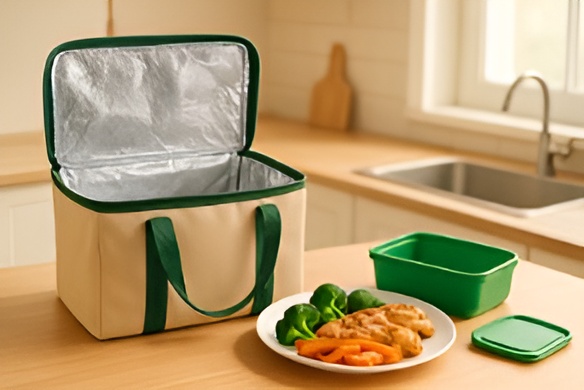
It slows down temperature change by using multiple layers that block heat transfer.
A good bag should:
● Keep cold food cold for longer
● Keep hot meals warm
● Protect against contamination
● Prevent leaking and odors
● Reduce food waste during transport
In simple terms, it works like a lightweight portable fridge or heater that you can carry anywhere.
2. Check the product material (most important section)
On Amazon, the three most important components are:
A. Outer Layer – durability
Common options:
● Oxford fabric – strongest, water-resistant
● Non-woven fabric – light and affordable
● Aluminum film – reflective but easier to scratch
Professional tip:
If you carry groceries or heavy items, Oxford fabric is the safest choice.
B. Middle Layer – insulation power
This is the layer that decides real performance.
Look for:
● EPE foam (2–5 mm) → everyday use
● Thicker PE foam (5–8 mm) → better cooling
● PU foam → premium, often used for delivery bags
Simple test:
If the seller does not show a cross-section photo of the foam, the foam is often too thin.
C. Inner Layer – food safety & easy cleaning
Two choices:
● PEVA
– Food-safe
– Waterproof
– Easy to wipe
– Best for daily lunch, groceries
● Aluminum foil
– Strong reflection
– Better for strong cooling
– More fragile if used with sharp items
Professional recommendation:
For daily use → choose PEVA
For strong cooling → choose aluminum foil
3. Choose the correct size (avoid the most common mistake)
Many Amazon buyers return bags because of size confusion.
Use this quick guide:
● Lunch or office: 6–10L
● Grocery shopping: 15–25L
● Family picnic: 25–35L
● Cold-chain or delivery: 35–50L
Real-life example:
Choosing a small bag for a family picnic feels like trying to fit a weekend’s groceries into a shoe box—it simply doesn’t work.
4. Evaluate insulation performance (a more practical approach)
Do not rely only on claims such as “keeps cold for 12 hours.”
These numbers are often tested under ideal conditions.
Instead, check:
● Whether buyers mention real-time performance
● Whether cold items lasted the whole picnic
● Whether icepacks melted too quickly
● Whether hot meals stayed warm after 2–3 hours
● Whether users mention temperature change in summer vs winter
If reviews repeatedly mention “cold lasted only 1 hour,” avoid the product.
5. Look closely at stitching quality
A bag with great insulation but poor stitching will still fail.
Check these details:
● Reinforced handles with X-shaped stitching
● No loose threads in product photos
● Wide binding around edges
● Strong bottom panel for heavy groceries
If users mention “handle broke after one week,” stay away.
6. Check the zipper quality
A broken zipper makes the whole bag useless.
Look for:
● Double zipper heads
● Thick zipper track
● Easy grip pulls
● Smooth closing in videos or photos
If reviews mention “zipper separates” or “zipper stuck,” consider another model.
7. Read customer reviews with purpose
Instead of just checking the star rating, scan for:
● Real-life photos
● Comments on cooling or heating time
● Feedback on odor
● Mention of leaking
● Whether the bag collapses or keeps shape
A translation of real Amazon mistakes buyers often share:
● “Looked big in pictures, but tiny in real life.”
● “Foam layer too thin—no insulation.”
● “Smells like chemicals.”
These are clear warning signs.
8. Identify a trusted Amazon seller
A reliable seller usually provides:
● Clear product dimensions
● Material breakdown with photos
● Actual factory or workshop pictures
● Timely answers to customer questions
● Stable product listings (not new every month)
A stable seller means stable quality.
9. Balance price and quality
Super-low prices usually mean:
● Thin foam
● Weak handles
● Poor zippers
● Short lifespan
● No real insulation
A medium-priced bag with strong structure and proper foam lasts much longer and protects food better.
10. Quick Summary (Easy to Remember)
● Choose PEVA or aluminum inner layer
● Choose Oxford fabric outer layer for durability
● Look for EPE/PE foam (≥5 mm)
● Check size chart carefully
● Zoom in on stitching and zipper
● Read reviews about insulation time
● Pick a seller with factory photos and clear details
A good insulated bag keeps groceries fresh, drinks cold, meals hot, and reduces food waste.
Contact Information
For wholesalers and Amazon sellers who need bulk insulated bags, JiaRong Packaging provides factory-direct supply and customization.
Email: [email protected]
WhatsApp: +86-13868368539